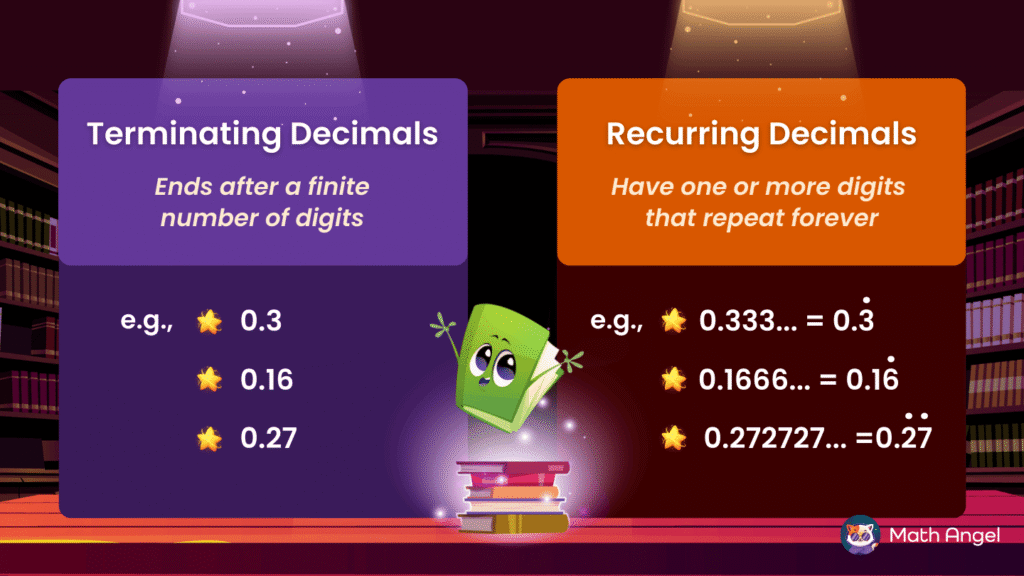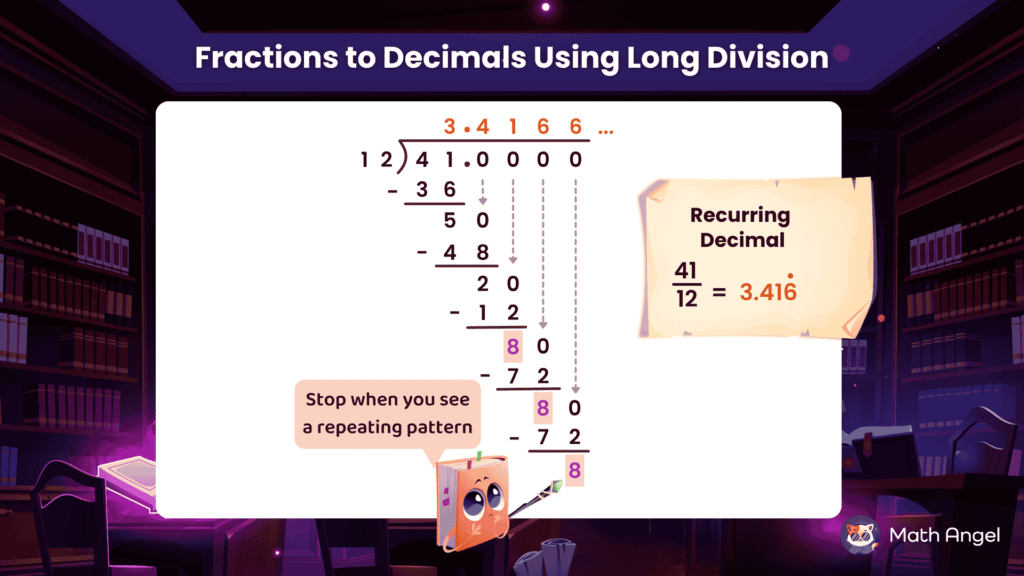
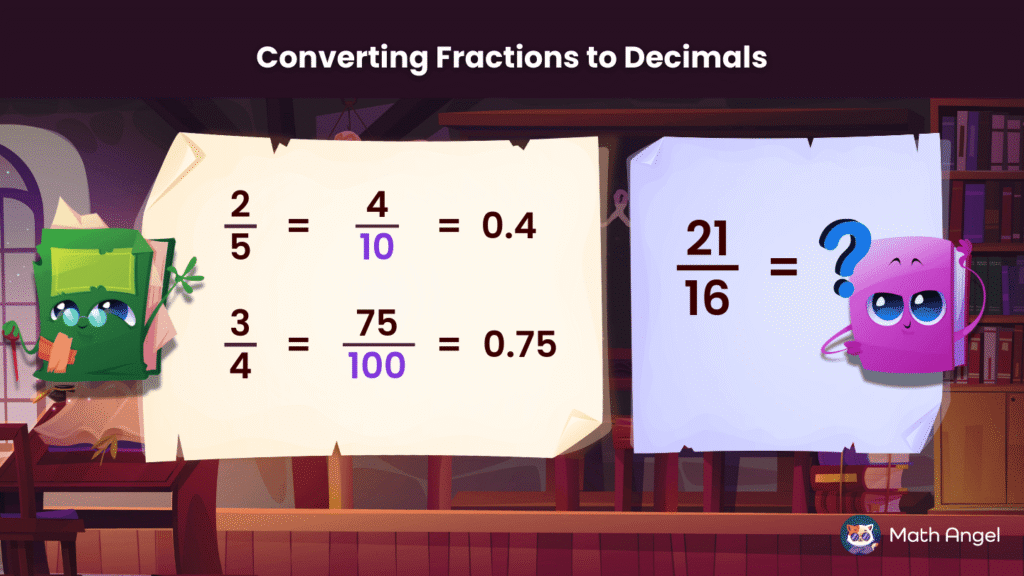
When the denominator doesn’t turn easily into 10 or 100, use long division to change the fraction into a decimal.
🛎️ Example: Turn $\frac{21}{16}$ to decimal
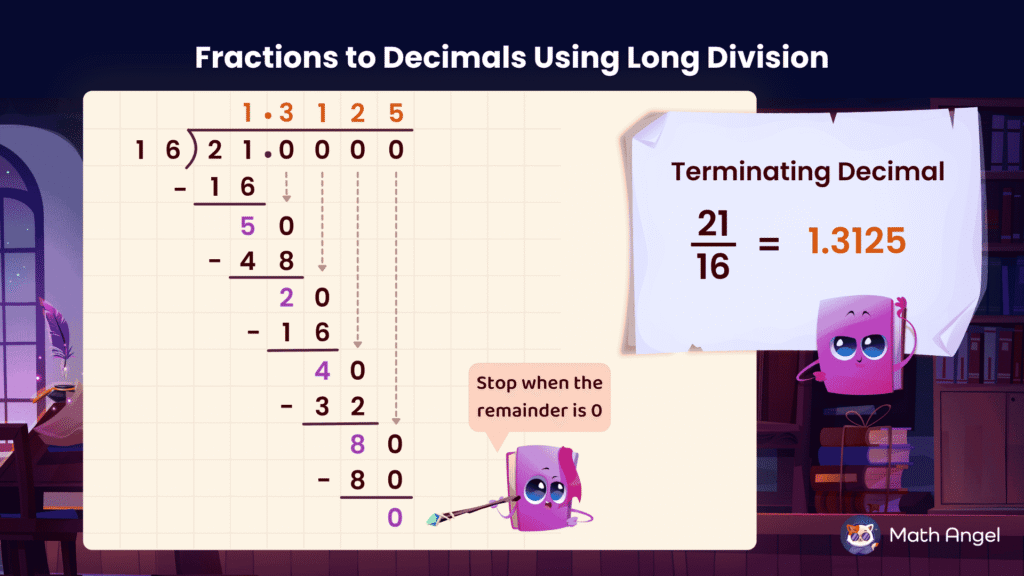
We divide 21 ÷ 16 using long division.
16 goes into 21 once → write1 on top.
Subtract 16 from 21, the remainder is 5.Add a decimal point and bring down a 0 to make 50.
50 ÷ 16 = 3 remainder 2 → write 3 after the decimal.Bring down another 0.
20 ÷ 16 = 1 remainder 4 → write 1 on top.Bring down another 0.
40 ÷ 16 = 2 remainder 8 → write 2 on top.Bring down another 0.
80 ÷ 16 = 5 remainder 0 → write 5 on top.
❇️ When the remainder becomes 0, you can stop.
$$\frac{21}{16} = 1.3125$$
1.3125 is a terminating decimal because it has a finite number of digits.